

By Dr. Tonya Coston, Ed.D.
Education Leader · Early Learning, Workforce & Family Engagement
Why Family Engagement Must Be Central to Dual Enrollment Success
Dual enrollment has become one of the fastest-growing strategies for expanding access to postsecondary education in the United States. By allowing high school students to earn college credit before graduation, dual enrollment has demonstrated positive relationships with college enrollment, persistence, academic achievement, and degree attainment (An, 2013a; An & Taylor, 2019; Buckley et al., 2022; Schaller et al., 2023).
As dual enrollment participation continues to rise nationwide, educational leaders must move beyond viewing these programs solely as academic opportunities. Dual enrollment represents a complex educational ecosystem that requires effective partnerships among K-12 schools, colleges, students, families, counselors, and administrators (Duncheon & Relles, 2020; Glennie & Edmunds, 2025).
While substantial research has examined student outcomes associated with dual enrollment participation, far less attention has focused on parents’ roles and educational leaders’ responsibility to support them. Findings from The Role of School Administrators and Counselors in Shaping Access, Support, and Outcomes in Dual Enrollment Programs suggest that parent engagement is not simply a supplemental feature of successful programs but rather a critical component of student success.
Parents as Essential Partners in Student Success
Research consistently demonstrates that families influence educational aspirations, college-going behaviors, and student persistence (Gee et al., 2020; Wright et al., 2025). Within dual enrollment programs, parents often serve as advocates, motivators, and sources of academic and emotional support.
Participants in this study described parents as highly supportive of dual enrollment opportunities and frequently willing to encourage students to pursue college-level coursework. Administrators and counselors reported that families recognized the academic and financial advantages associated with earning college credit while in high school.
These findings align with prior research demonstrating that families generally view dual enrollment as a pathway to college readiness, academic advancement, and reduced postsecondary costs (Edwards & Hughes, 2011; Andrews, 2004).
However, support for the opportunity did not necessarily translate into a complete understanding of program expectations.
Several participants described circumstances in which parents lacked awareness regarding the implications of course failure, academic policies, available supports, and the demands associated with college-level coursework. Such findings mirror broader national concerns regarding information gaps that affect access to and success within dual enrollment programs, particularly among historically underserved populations (Gewertz, 2019; Rivera et al., 2019; Xu et al., 2021).
These findings suggest that educational leaders must view family communication and engagement as strategic leadership responsibilities rather than administrative obligations.
Access Without Information Is Not True Access
Although dual enrollment is often discussed as an access initiative, scholars increasingly argue that participation alone does not ensure equitable opportunity (Hooper & Harrington, 2022; Griffin et al., 2024).
Research has documented disparities in enrollment and participation among students from lower-income households, first-generation college families, multilingual households, and historically marginalized communities (Williams & Perry, 2020; Hutchins et al., 2024).
The administrators and counselors in this study identified similar concerns. Participants described instances where families lacked knowledge about available opportunities, enrollment procedures, transferability of credits, or financial implications associated with participation.
Such findings support the growing body of literature suggesting that educational leaders must move beyond simply offering dual enrollment and instead focus on creating systems that ensure families understand how to access and benefit from these opportunities (Taylor et al., 2022; Garcia Tulloch, 2024).
As Griffin et al. (2024) argue, equitable dual enrollment requires intentional pathways that support students and families throughout the educational process rather than assuming equal access automatically results in equal outcomes.
Leadership Must Extend Beyond Enrollment
One of the strongest themes emerging from this study was the importance of communication.
Participants consistently emphasized that parents should understand academic expectations, program requirements, support services, and potential consequences before students enroll in dual enrollment courses. However, several participants also acknowledged that communication practices were not always consistent across institutions.
Previous research has similarly identified communication and coordination challenges among secondary schools, colleges, counselors, and families (Garcia et al., 2019; Martinez et al., 2017; Witkowsky & Clayton, 2019).
Effective leadership requires more than distributing informational materials or conducting annual orientation meetings.
School administrators should establish systemwide communication practices that clearly define:
Program expectations.
Academic performance requirements.
Available support services.
Procedures for addressing academic difficulties.
Responsibilities of school and college personnel.
Parent communication protocols.
Proactive communication is particularly important because college instructors may not communicate directly with parents regarding attendance concerns or academic difficulties. Without clearly defined intervention procedures, families may remain unaware of problems until a student’s academic standing has already been affected.
The Complementary Roles of Administrators and Counselors
The findings of this study also highlighted distinct but interconnected responsibilities among educational leaders.
Administrators were primarily responsible for developing partnerships, allocating resources, establishing policies, and ensuring program sustainability. Counselors, meanwhile, played a more direct role in student advising, academic monitoring, family communication, and individualized support.
These findings align with previous research emphasizing the pivotal role counselors play in helping students successfully navigate dual enrollment opportunities (Hanson et al., 2015; Holland-Wasdin, 2023; Stich et al., 2024).
At the same time, counselors cannot bear responsibility for program success alone. Administrators must create the organizational structures that enable effective counseling, communication, and student support.
Viewed through a systems-thinking framework, successful dual enrollment implementation depends upon the interaction of multiple stakeholders working toward common goals (von Bertalanffy, 1972; Meadows & Wright, 2015; Akpan, 2025). When communication breakdowns occur among parents, counselors, administrators, and college partners, student success may be jeopardized despite the availability of educational opportunities.
Supporting Families Through Comprehensive Systems
Participants emphasized that students often require support extending beyond academic advising.
Tutoring, academic intervention programs, emotional support services, progress monitoring, and regular check-ins were identified as important mechanisms for helping students succeed.
These findings parallel research highlighting the importance of coordinated support structures in promoting persistence and positive postsecondary outcomes among dual enrollment participants (Day et al., 2020; Giani et al., 2025; Purnell et al., 2024).
Importantly, participants suggested that families should understand how to access these resources before students encounter difficulties.
This perspective represents a shift from reactive intervention toward proactive support, reinforcing the notion that leadership involves anticipating student needs rather than responding exclusively to crises.
Equity Requires Intentional Family Engagement
Perhaps the most significant implication of this study involves educational equity.
National conversations surrounding dual enrollment increasingly emphasize not only participation rates but also who benefits from participation and who remains underserved (Fink et al., 2023; Griffin et al., 2024; Rodriguez & Gao, 2021).
Participants in this study recognized that some families face barriers related to language, scheduling constraints, limited college knowledge, transportation concerns, and inconsistent communication.
Consequently, leaders must recognize that traditional parent engagement strategies may unintentionally exclude families they hope to serve.
Educational leaders should consider multiple methods for engaging families, including:
Flexible scheduling options.
Virtual information sessions.
Multilingual resources.
Recorded presentations.
Family advisory groups.
Ongoing opportunities for feedback.
When family engagement is intentionally designed to reduce barriers, dual enrollment becomes more accessible, equitable, and responsive to community needs.
A Call to Action for Educational Leaders
The findings of this study suggest that educational leaders should reframe how success in dual enrollment is measured.
Enrollment numbers, credit accumulation, and course completion rates remain important indicators; however, they do not provide a complete picture of program effectiveness.
Leaders should also evaluate:
Parent understanding of program requirements.
Communication effectiveness.
Family satisfaction.
Accessibility of support services.
Quality of school-college partnerships.
Equity of access across student groups.
Ultimately, dual enrollment should be viewed as more than an academic initiative. It is a collaborative endeavor requiring coordinated leadership, intentional communication, and meaningful family engagement.
Parents should not be expected to navigate an unfamiliar college landscape without guidance. Likewise, students should not have to experience academic difficulties before support systems are activated.
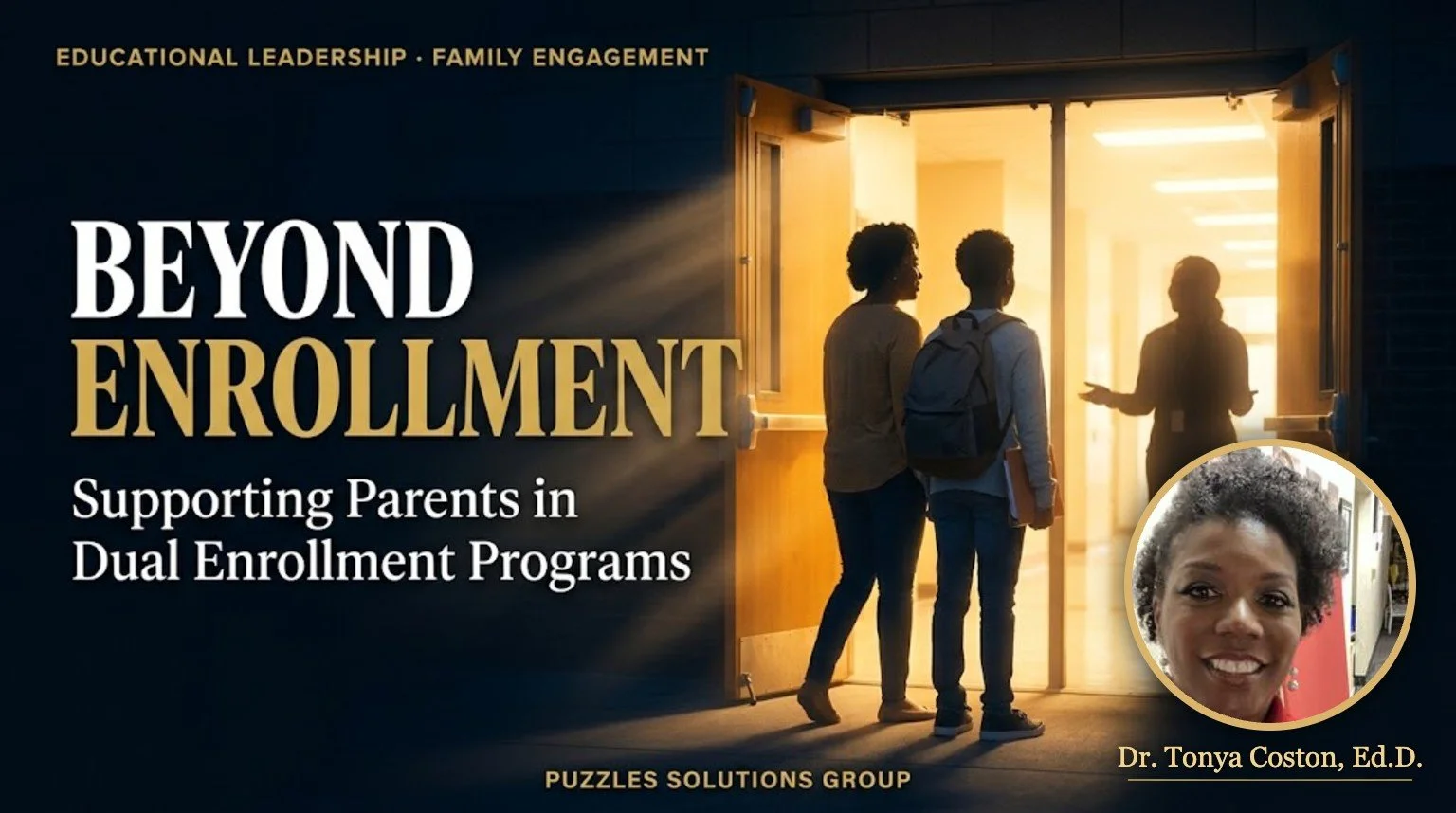
The responsibility of educational leadership extends beyond opening the door to opportunity. It includes ensuring that students and families possess the information, resources, and support necessary to successfully walk through that door.
When educational leaders support parents, they strengthen the entire dual enrollment experience. When families are informed, included, and empowered, students are better positioned to achieve the outcomes dual enrollment programs were designed to make possible.
References
Akpan, B. (2025). Systems thinking—Ludwig Von Bertalanffy, Peter Senge, Donella Meadows. In B. Akpan & T. J. Kennedy (Eds.), Science education in theory and practice. Springer.
An, B. P. (2013a). The impact of dual enrollment on college degree attainment: Do low-SES students benefit? Educational Evaluation and Policy Analysis, 35(1), 57–75.
An, B. P., & Taylor, J. L. (2019). A review of empirical studies on dual enrollment: Assessing educational outcomes. In M. B. Paulsen & L. W. Perna (Eds.), Higher education: Handbook of theory and research (Vol. 34, pp. 99–151). Springer.
Andrews, H. (2004). Dual credit research outcomes for students. Community College Journal of Research and Practice, 28(5), 415–422.
Buckley, P. R., Pendergast, P., Klopfenstein, K., Poast, K., & Ramsay, L. (2022). Does dual enrollment improve progression through college and earnings? The High School Journal, 105(3), 217–242.
Day, M. C., Kelley, H. M., Browne, B. L., & Kohn, S. J. (2020). Assessing motivation and learning strategy usage by dually enrolled students. Smart Learning Environments, 7, Article 22.
Fink, J., Griffin, S., Tulloch, A. G., Jenkins, D., Fay, M., Ramirez, C., Schudde, L., & Steiger, J. (2023). DEEP insights: Redesigning dual enrollment as a purposeful pathway to college and career opportunity. Community College Research Center.
Garcia, H. A., Eicke, D., McNaughtan, J., & Harwood, Y. (2019). Understanding dual credit programs: Perspectives from faculty, staff, and administrators. Community College Journal of Research and Practice, 44(8), 584–594.
Giani, M. S., Khandekar, S., & Porter, J. (2025). Access, supports, and performance in dual enrollment: A COVID-19 case’s implications for equity. AERA Open, 11.
Gewertz, C. (2019, February 5). Students from educated families more likely to take dual credit courses. Education Week.
Griffin, S., Steiger, J., Garcia Tulloch, A., Fink, J., & Jenkins, D. (2024). Dual enrollment equity pathways. New Directions for Community Colleges, 2024(207), 47–60.
Hanson, J. M., Prusha, T., & Iverson, C. (2015). Principal, teacher, and counselor views of concurrent enrollment. New Directions for Community Colleges, 2015(169), 71–81.
Holland-Wasdin, A. (2023). Teacher and counselor perceptions of dual enrollment in Georgia (Doctoral dissertation, Valdosta State University).
Martinez, M. A., Valle, F., Cortez, L. J., Ponjuan, L., & Sáenz, V. B. (2017). School leaders’ approaches in creating and maintaining dual enrollment opportunities. Leadership and Policy in Schools, 17(4), 516–540.
Meadows, D. H., & Wright, D. (2015). Thinking in systems: A primer. Chelsea Green.
Purnell, R. D., Cooper, D., Karadjeff, K., & Rodriguez-Kiino, D. (2024). Ready, set, launch baseline academic outcomes for students participating in dual enrollment. Concurrent Enrollment Review, 2(1).
Rivera, L. E., Kotok, S., & Ashby, N. (2019). Access to dual enrollment in the United States: Implications for equity and stratification. Texas Education Review, 7(2), 14–29.
Rodriguez, O., & Gao, N. (2021). Dual enrollment in California: Promoting equitable student access and success. Public Policy Institute of California.
Schaller, T. K., Routon, P. W., Partridge, M. A., & Berry, R. (2023). A systematic review and meta-analysis of dual enrollment research. Journal of College Student Retention: Research, Theory & Practice, 27(1), 263–289.
Stich, A. E., Spencer, G., Johnson, B., & Baser, S. (2024). School counselors’ sensemaking of a dual enrollment policy in Georgia. Innovative Higher Education, 49, 71–90.
Taylor, J. L., Allen, T. O., An, B. P., Denecker, C., Edmunds, J. A., Fink, J., & Chen, W. (2022). Research priorities for advancing equitable dual enrollment policy and practice. University of Utah.
Velasco, T., Fink, J., Bedoya, M., & Jenkins, D. (2024). The postsecondary outcomes of high school dual enrollment students: A national and state-by-state analysis. Community College Research Center.
von Bertalanffy, L. (1972). The history and status of general systems theory. Academy of Management Journal, 15(4), 407–426.
Williams, A., & Perry, A. (2020). Prioritizing equity in dual enrollment. Education Commission of the States.
Witkowsky, P., & Clayton, G. (2019). What makes dual enrollment work? High school counselor perspectives. Community College Journal of Research and Practice, 44(6), 427–444.
Wright, A., Kara, Y., Cunningham, L., Johns, R., Ticzon, C., & Petrosino, A. J. (2025). Exploring profiles of college access program participants associated with postsecondary enrollment. Journal of College Student Retention: Research, Theory & Practice.
Xu, D., Solanki, S., & Fink, J. (2021). College acceleration for all? Mapping racial gaps in advanced placement and dual enrollment participation. American Educational Research Journal, 58(5), 954–992.
About the author: Dr. Tonya Coston, Ed.D., has spent more than 25 years leading statewide education and workforce initiatives in New Jersey, including service as Deputy Assistant Commissioner overseeing early childhood programs at the New Jersey Department of Education.
Like, follow, subscribe, and share this column with an educator, counselor, or parent who could use it.