

Before the Label: Looking More Closely at a Child’s Behavior
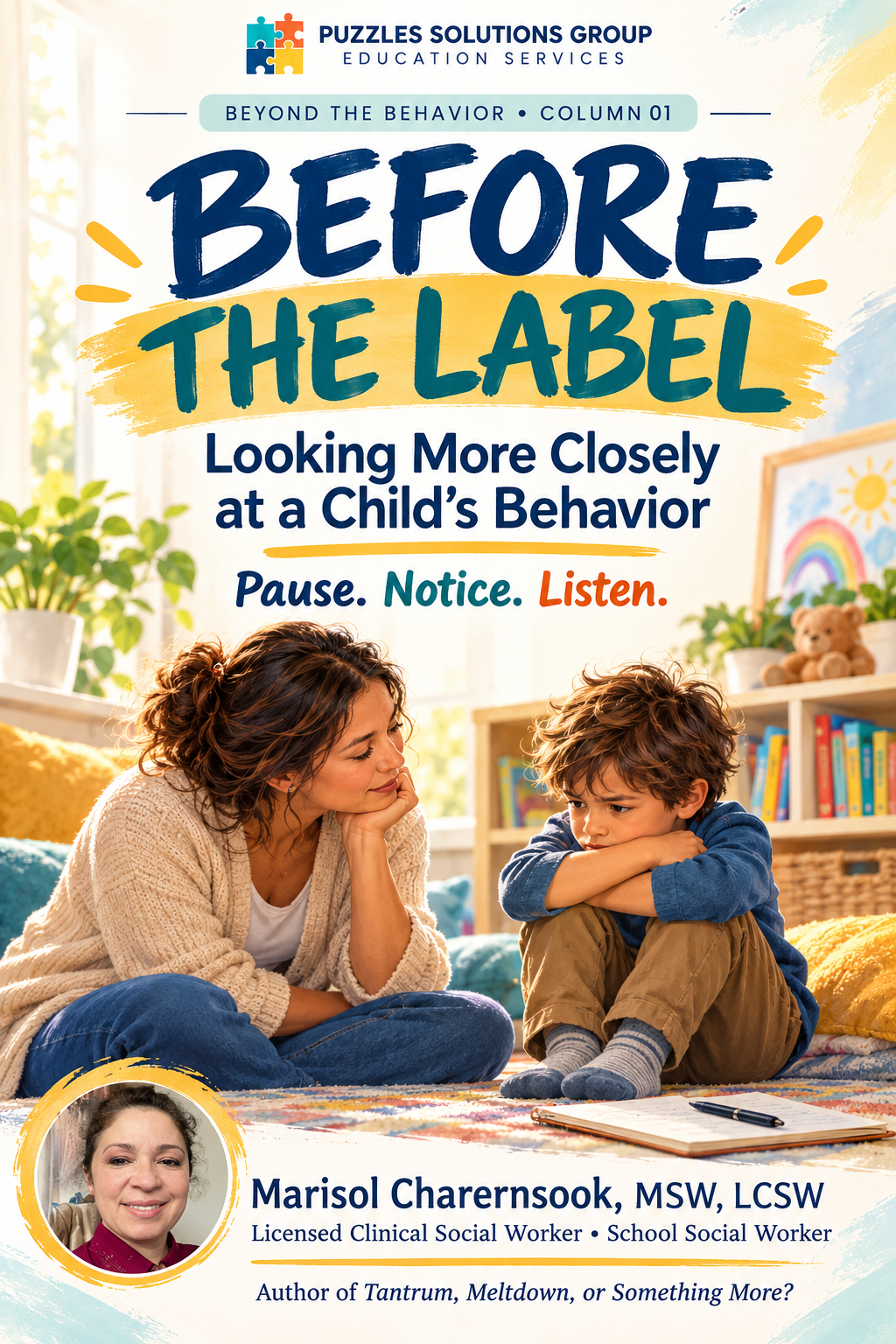
By Marisol Charernsook, MSW, LCSW
Licensed Clinical Social Worker · School Social Worker
Beyond the Behavior — Column 01
A child pushes an assignment away. A student stops answering questions. A familiar morning routine ends in tears. Before anyone has asked what happened, the explanation may already be circulating: lazy, defiant, spoiled, attention-seeking.
Those words describe an adult’s interpretation. They do not tell us what the child found difficult, what happened just before the moment, or what kind of help might be useful.
The starting point of this column is a different question: What do we need to understand before we decide what this behavior means?
That question sits at the heart of Tantrum, Meltdown, or Something More? It invites parents and educators to look more closely while keeping expectations, boundaries, and safety in view. Understanding a child and setting a limit can happen in the same conversation.
Describe what happened before explaining why
“She refuses to learn” is a conclusion. “She closed the workbook after reading the first instruction and did not begin the task” is an observation. The second sentence gives a family or school team something to discuss.
What was the instruction? Had the child completed a similar task before? Was help available? What did the child say? What happened when the adult offered another way to begin?
These questions do not establish a diagnosis. They help adults separate the event from the story they have attached to it. A useful record can be brief: the activity, what happened immediately beforehand, the child’s observable response, and what happened next. Include the child’s explanation when the child is able and willing to offer one.
Look at the task, not only the reaction
Consider a hypothetical student who participates comfortably in class discussions but puts their head down whenever independent writing begins. An adult might call the student unmotivated. A closer conversation might reveal that the student has ideas but does not know how to organize the first sentence. Or it may reveal something entirely different.
The point is not to replace one quick explanation with another. It is to test our assumptions through respectful questions and appropriate support.
A teacher might ask, “Which part feels hardest to start?” A parent might ask, “Can you show me where you got stuck?” The team could discuss whether a planning conversation, clearer directions, or another appropriate classroom adjustment would help the student participate. Any support should fit the individual student and be reviewed for usefulness.
The same approach applies outside school. Instead of beginning with “You always make mornings difficult,” an adult can identify the actual obstacle: getting dressed, stopping an activity, finding materials, or leaving the house. A specific problem is easier to discuss than a judgment about a child’s character.
Listen without deciding the answer in advance
Listening is more than waiting for a child to confirm an adult’s theory. It means allowing an explanation that may be incomplete, unexpected, or different from what another adult observed.
For toddlers and preschoolers, CDC guidance emphasizes clear communication and helping children name feelings. That guidance is designed for young children; older students need language and opportunities for participation appropriate to their age and circumstances. [1]
An adult can acknowledge a feeling without agreeing to every action: “You seem frustrated. The materials still need to stay on the table.” Keep the language understandable and the next expectation specific. If a situation is unsafe, attend to immediate safety rather than trying to finish an explanatory conversation in that moment.
Afterward, return to the question of what happened and what might make the next attempt more manageable. The goal is to understand enough to respond thoughtfully, not to win an argument about whether a child had a right to feel upset.
Bring useful information to the home-school conversation
Parents and educators may see different sides of the same child. A student may manage one setting more comfortably than another. Differences in observation are worth exploring rather than treating as evidence that someone is exaggerating or failing.
Compare specific situations. Ask what the child was expected to do, what help was available, and whether there were times when the same activity went more smoothly. Agree on one next step, who will carry it out, and when the adults will discuss what happened.
Keep that conversation private. A public comment thread is not the place to share a student’s personal history or ask strangers to diagnose a child. When concerns persist, become unsafe, or interfere with daily life, bring them to the appropriate school professional or healthcare provider. An article can help organize questions; an individual evaluation requires individual attention.
A message worth carrying forward
A difficult moment does not tell the whole story of a child. Neither does a label. Parents and educators can hold a child accountable while remaining curious about the demands, circumstances, and unmet questions surrounding a behavior.
Before the next conclusion, try three steps: pause before interpreting, notice what actually happened, and listen for information you do not yet have.
The purpose is not to explain away every difficulty. It is to give the child—and the adults trying to help—a better starting point.
Further reading
Publisher promotion · Ad · Paid links. As an Amazon Associate I earn from qualifying purchases.
Tantrum, Meltdown, or Something More? by Marisol Charernsook explores behavior, adult responses, patterns of concern, and collaboration between families and schools. Review the description and sample to decide whether it fits your needs:
View book on Amazon
For a related classroom conversation about belonging and student leadership, explore Micah’s Call by Dr. Nacovin J. Norman, Sr. It is a novel, not a clinical guide:
View book on Amazon
Sources
Book foundation: Tantrum, Meltdown, or Something More?, Author’s Note and Introduction; manuscript supplied through Puzzles Publishing.
[1] CDC, Tips for Connecting and Communicating, Essentials for Parenting Toddlers and Preschoolers: Read source
Educational information; not an individual evaluation, diagnosis, or treatment plan. The classroom example is hypothetical.